Taryn's Unique Learning Email Facebook Instagram Pinterest Bloglovin TPT Store Home About Me TPT Shop Freebies Contact


Showing posts with label literacy centers. Show all posts

Monday, December 1, 2025

My 5 Favorite January Literacy Centers (That Keep Kids Learning and You Sane!)

Are you a fan of January in the classroom? For many teachers, this can be a tough month, but don't worry. . .  we're going to find that silver lining today! Even if your students come back from break a little extra chatty, wiggly, or still stuck in “holiday mode,” your January literacy centers can be the anchor that brings everyone gently back into routine. Having engaging, winter-themed activities ready to go can make all the difference in keeping your sanity and your lesson plans on track!

These January literacy centers will keep kids learning and keep you sane all winter long!

Let's Boost Engagement This January!

We all know that aside from being the longest (ha!) month of the year, January has its challenges! Kids return excited, loud, and bursting with stories about their break, and getting everyone regulated again takes time. That’s why thematic centers work so well this month! They feel fresh and fun for students, while offering the structure, predictability, and focus they desperately need after weeks away from school. 

Not to mention, fun winter themes re-engage those sleepy brains, make transitions smoother, and help your classroom feel calm and cohesive again. And when centers flow, your whole day flows. I think we ALL need that in January! Ready to make this month a great one? Let's do it! Here are 5 of my favorite activities for January. 

1. Winter Same & Different Visual Discrimination Cards

These visual discrimination cards are a quick and meaningful warm-up activity for primary learners.
If you want a quick warm-up that’s meaningful and gets the wiggles out, these cards are your new January bestie. Visual discrimination is such an underrated pre-reading skill, and this set makes teaching it completely effortless! 

In this resource, you get 84 task cards that print 4 to a page. Each task card features two different pictures for your students to study and determine if they are the same or different. This activity is perfect for whole group time, such as your morning meeting, and also works beautifully in small groups. You can even pair kids up with a partner and have them switch off completing the task card, too! 


Why You and Your Kids Will Love It

It’s a silent, movement-based game (yes… SILENT). Students will study the two pictures and use hand signals to tell you if the pictures are the same or different. They will put both hands up and wiggle their fingers for the same. For different, they will put their arms crossed in front. The kids LOVE this because it feels like a fun game, and you'll love it because it's a nice, quiet, and calm activity to roll into after break. 

Try using this as a transition when your class needs a minute to reset, or keep a box of cards by your carpet area for instant time-fillers. These cards will come in handy throughout your day! 


2. Fill the Missing Letter Cards (Uppercase & Lowercase)

Using this January literacy center, students will fill in the missing letter.
If your January literacy centers need something hands-on and independent, these Fill the Missing Letter Cards are the perfect choice! They give students tons of alphabet fluency practice without feeling boring. Plus, with this activity, you can choose from using magnetic letters, alphabet tiles, or just a dry-erase marker to complete it. This makes it fun and easy to switch it up!

Inside this resource, you get two full sets of cards, one uppercase, one lowercase. Each card shows part of an alphabet sequence with one letter missing. Students will identify the missing letter and fill it in with a magnetic letter, letter tile, or dry-erase marker. Just be sure to laminate them first! 

I've also included recording sheets for some extra accountability and practice. Each card is numbered, so students will just make a note of which card they're working on and fill in the missing number. It’s simple, satisfying, and a great confidence-builder for emerging readers!


Why You and Your Kids Will Love It

This activity fits anywhere in your day, making it super versatile! Whether you use it during centers, as an activity for your morning tubs, or a round of SCOOT, it's sure to be a hit! And speaking of SCOOT, this option allows kids to get up and moving as you rotate, which brings in even more engagement. 

With this activity, you get meaningful alphabet practice in a format that practically runs itself! In centers, students can work independently at their own pace, which means fewer interruptions and smoother rotations for you.

Try putting uppercase cards out one week and lowercase the next, or keep the black-and-white version in your morning tubs to save ink. These cards are the definition of low prep, high impact!


Winter Letter Recognition & Beginning Sounds Set

Practice letter recognition and letter sounds with a fun winter theme using this January literacy center.
If you want a center that truly feels like a game, this Winter Letter Recognition & Beginning Sounds Set is the one kids never get tired of. It sneaks in letter naming, matching, and phonics work all at once, making it a great fit for both circle time and independent centers.

The resource includes multiple card types and recording sheets to allow for full flexibility! You get uppercase letters, lowercase letters, and picture cards for beginning sounds for both cards and worksheets. I've also included a picture key for the cards because we all know that it can sometimes get tricky! 

To play, you will choose the cards you want to work with, as well as the recording sheet style. Place all the cards face down, "fishing pond" style. Then, students draw a card, find the match on their page, and color it in. Students can match capital to lowercase, letters to pictures, or use the cards for a mix-and-match activity. 


Why You and Your Kids Will Love It

The versatility is what makes this gold. There are SO many ways to play! You can set up a “fishing” bin where kids draw a card and find the matching letter or picture on their recording sheet, or pull out the cards for rapid-fire warm-ups that boost fluency without taking extra prep time. 

For a winter twist, print the cards on white paper and cut them out.  Then wad them up to make snowballs.  Students will grab a snowball, open it up, and complete the task. Then they can wad it up again and set it aside for the next person.

This is also a great activity that is easy to differentiate. Emerging learners can work with just a handful of letters, while more experienced readers can mix all three decks for a bigger challenge. This is one of those centers that grows with your class and adapts to individual needs easily. Plus, it's a super simple setup and includes endless ways to play. 


4. CVC Word Winter Work Mats

These cvc word winter work mats are perfect for January literacy centers.
These CVC Word Winter Work Mats are EVERYTHING for January. They take your daily CVC routine and turn it into a consistent, visual, predictable literacy center your students will walk into and instantly know what to do. Each mat includes a CVC word picture and sound boxes shaped like snow-covered houses. Students will tap each sound, build the word with magnetic letters or letter tiles, and then write it on the matching recording sheet. 


Why You and Your Kids Will Love It

The picture cues remove the guesswork and the frustration for your emerging readers.  Plus, the combo of the house-shaped boxes and magnetic letters makes segmenting feel like a hands-on puzzle. Kids stay focused longer, and you get engaged, phonics-rich practice that supports decoding and spelling.

For even more fun, laminate a class set to use during your small groups. Practice in depth with your kids, and when it's time to rotate, send your kids to the next table with their recording sheet and challenge fast-finishers to write a sentence using one of their CVC words. This is the kind of center that settles your room, lowers your stress, and fills your January literacy block with meaningful, independent practice! 


5. Winter Sight Word Treasure Hunt (Fry's First 100)

Students can practice sight words with a fun winter twist using this engaging pocket chart activity.
If your class needs a high-energy sight word review after winter break, this Winter Sight Word Treasure Hunt is going to be your new go-to. Think of it as a sight word search meets treasure hunt game! Plus, it's simple to set up, but it brings maximum engagement! Yes, please!

In this resource, you get Fry's First 100 word cards plus matching treasure cards. To play, add the sight words to a pocket chart, hide "treasures" behind a few, and let the reading and searching begin! Kids will read a word, remove the card, and check to see if a treasure is hiding underneath. It's such a fun way to get your kids excited to read and practice those sight words!


Why You and Your Kids Will Love It

It’s fast-paced, fun, and perfect for whole-group days when everyone’s a little wiggly. You can also scale it down for centers using 10-15 target words at a time. Students take turns reading, checking, and celebrating, all while getting in tons of sight word fluency.

Use the black-and-white cards for assessments or quick progress checks, and reuse the treasure cards during math, transitions, or Friday rewards. This one is a classroom favorite all winter long!


Make Literacy Fun This January!

As you ease back into routines this month, I hope these January literacy centers give you that perfect mix of calm, consistency, and meaningful practice. Reviewing the skills that you learned in the first half of the year is the perfect way to ease back into learning after a long winter break. Each activity is designed to be low-prep for you and highly engaging for your students. This is the sweet spot we’re all chasing in the winter months! 

Whether you need quick warm-ups, independent centers that practically run themselves, or whole-group games that get kids moving and laughing, these resources will help you start the new year with confidence. Here’s to a cozy, happy January filled with growth, routine, and lots of little literacy wins! 

Oh, and if you need more literacy ideas for winter, you know I've got you covered! Check out all of my favorites right here!

Looking for More?

Check out these posts next for more fun literacy ideas!

Pin It!

Make sure to pin this post on Pinterest so that you can come back to it when you're ready! 

Looking for stress-free January literacy centers? These are my 5 favorite low-prep activities that keep students engaged while giving you back precious planning time! From winter letter recognition to sight word practice and building cvc words , these winter centers make ELA a breeze all month long.

Monday, November 17, 2025

Low-Prep Pocket Chart Poetry Centers That Keep Kids Reading All Year Long

If you’ve ever wanted a literacy center that builds fluency, supports phonemic awareness, reinforces sight words, and actually runs itself… poetry is the secret. Young learners love poems. The rhythm, repetition, and predictable patterns make it feel like play, but underneath, there is powerful reading instruction happening. If this sounds like exactly what you need to boost engagement and excitement about reading, you're going to LOVE what I'm sharing today! Come along to learn how poetry pocket chart centers will be a total game-changer in your center time routine. 

These low prep pocket chart poetry centers will keep kids reading all year long.

The Literacy Center Dilemma 

A low prep poetry center solves literacy center dilemmas.
Tell me if this rings a bell for you. . .  So many teachers love the idea of literacy centers, but not the reality of running and managing them. You want students working independently, meaningfully, and with confidence. But often what happens is something else altogether. It usually goes something like this:

  • Students forget the directions
  • They finish too quickly
  • They get overwhelmed and stall
  • They aren't able to work independently
  • The task is not aligned with what your kids need practice with
  • You feel like you're reinventing the wheel every month
  • You're spending hours prepping tons of center time materials

The result? You spend more time managing the center than it gives back to you. I think we have ALL been here before, right?! The good news is that there's a better solution. A poetry center solves this problem because the structure never changes. Once students learn how to use it, they can work independently over and over again, even when the poem itself changes. 


Benefits of Poetry Centers in the Primary Classroom

Poetry centers have many benefits in the classroom.
I promise I'll share my favorite low-prep resource to support this, but first, let's talk benefits! Poetry offers so many benefits for young learners, especially in the primary classroom. Its rhythm, rhyme, and repetition make it naturally engaging, helping students notice patterns in language and sound. Reciting and interacting with poems builds phonemic awareness, strengthens vocabulary, and reinforces sight word recognition in a fun, memorable way. 

Poetry also supports reading fluency, as students practice expression, phrasing, and pacing while rereading familiar lines. And because poems are naturally repetitive and rhythmic, students feel successful, which builds independence, confidence, and motivation to read. Beyond the academic skills, poems encourage a love of language and foster creativity. They will have your kids smiling and excited to learn!

 The bottom line is that integrating poetry regularly creates a rich literacy environment that is both joyful and highly educational. And. . .  I've got a pocket chart poetry center that will make implementing it an absolute breeze!

Get Started with Pocket Chart Poetry Centers

Include monthly poetry centers in your plans using this simple, low prep resource.
Ready to see this action?! Let's talk about how it all comes together. In my classroom, I used Monthly Pocket Chart Poetry Centers that aligned with the holidays, seasons, and themes. The center consists of an anchor chart with the full poem, as well as word cards that are cut into strips and used for building the poem. The idea is that you only need to teach the routine once, and then it carries your students all year long as you switch it out each month. You can use them for whole groups, small groups, and of course, center time!

Begin by selecting your poem of the week or month and displaying it in your pocket chart, where students can clearly see and interact with it. This becomes the shared reading piece that everyone practices together. I recommend placing this at the top of the chart, or on a wall nearby. 

Next, prep the word cards by printing, laminating, and cutting them apart. These cards are what students will use to build and rebuild the poem during center time. There is a color set and a black and white set in each pack. You can place the black cards in the chart first and have the kids match up the color ones, or have them build from scratch. I like to store them in baskets when not in use. 


Using the Pocket Chart Poetry Center

Add a pocket chart pointer to your activities to make poetry centers even more engaging.
For a simple, kid-friendly set-up, make sure the poem is on a wall nearby or above the chart, place the colored word cards in a basket underneath, and place the black word cards in the pocket chart. I like to add a pointer as well. As a side note, it's important to show the kids how the center looks when they start, so they can return it to this setup for the next person. 

Introduce the Poem with Your Whole Group


Once the materials are ready, introduce the poem during whole-group instruction. Read it together, track the print as you read with a pointer, clap the rhythm, talk about rhyming words, and model reading with expression. This step builds familiarity and confidence so students know the poem before encountering it independently.

Rotate to the Poetry Center 

Once students understand the poem, they can practice it again when they rotate to the poetry center. Have your kids start by re-reading the anchor poem, then move into matching or building. Here's a step-by-step look at how I recommend doing this: 

I like to pair kids up with a partner and have one child hold the pointer and read the poem aloud on the anchor chart. The other child can match the color word cards to the black word cards in the pocket chart as it's read aloud. Then, have them switch and try again! 

Once they have done this a few times, challenge them to rebuild the poem from scratch, either with a partner or independently. This is such a simple activity that your kids will pick up fast! 


How to Keep It Going All Year Long

Remember, the task stays the same every time, only the poem changes. No new directions. No reteaching. Just meaningful, confidence-building reading practice on repeat. When you're ready to swap the poem, it's quick and simple! Just bag up the current set, store it away, and add your new seasonal set. This allows you to match poems to monthly or seasonal themes and keep what you're learning feeling fresh! 

More Ways to Weave Poetry Centers into Your Routine 

I Can Read Notebooks are another great way to weave poetry practice into your classroom routine.
Aside from dedicated center time, there are many other great ways to use these poetry centers in your classroom. I loved using the poem during our morning meeting so that everyone got familiar with it. I'd call up a volunteer to be my official pointer, and we'd all recite it together. It's a great, rhythmic addition to your morning routine that students truly love!

Another fun idea is to keep poems in a binder or poetry folder. Students love rereading past favorites! We like to use these, I Can Read Notebooks, to keep all of our poems safely tucked away. You might even consider sending a copy of the poem home as part of your weekly homework routine. Have students circle or highlight sight words, vocab words, and more!

What’s Included in the Build a Poem Pocket Chart Bundle

12 monthly poems, poem posters, word cards and instructions for use are all included in this set of poetry centers.
Ready to make this part of your classroom routine?! I know you will love the Build a Poem Pocket Chart Bundle! For every month of the year, you’ll find a seasonal or thematic anchor chart poem along with the same poem in a pocket chart format. Here's what's in the full year bundle:

  • 12 Monthly Poems 
  • Printed Poem Posters
  • Word Cards in Color and Black and White 
  • Instructions for Use

The predictable structure of these activities supports a wide range of early literacy skills. Students practice left-to-right tracking, return sweeps, one-to-one correspondence, and voice-print matching. They also get built-in opportunities to identify beginning sounds, recognize rhymes, improve reading fluency and expression, and develop sight word recognition and automaticity. 


Ready to Try It in Your Classroom?

Don't wait to add this to your literacy routine, friends! Grab the Pocket Chart Poetry Bundle here

A year-round poetry center helps students gain fluency, phonemic awareness, confidence, and joy in reading, all while working independently. But the best part is that you can set up your poetry center once, make a few small swaps each month, and use it for years to come. It’s simple, engaging, predictable, and meaningful. Plus, I know your students will love it! Click the image below to grab the whole year bundle!

Set up your poetry center with this low prep pocket chart poems bundle for the year.

Looking for More?

Be sure to check out these posts next for more classroom learning ideas!

Pin It! 

Make sure to pin this post on Pinterest so that when you're ready to get started with pocket chart poetry centers, you'll have everything you need in one place!


Keep your students engaged in reading all year long with these low-prep pocket chart poetry centers! Perfect for literacy stations or small groups, these interactive poems make reading fun and easy to manage—just print, cut, and go! Ideal for building fluency, sight word recognition, and confidence in young readers.

Tuesday, September 23, 2025

November Pocket Chart Fun for the Primary Classroom

November is the perfect month to engage your students with festive, hands-on activities that build literacy and phonemic awareness while keeping learning fun. Pocket charts are an excellent way to create interactive lessons that students can explore independently, and they’re perfect for the primary classroom. In this post, I’m sharing some must-have November pocket chart activities that are ready to use, low prep, and incredibly effective!

Add these fun pocket chart activities to your November plans in your primary classroom.

Why Pocket Charts Work So Well in the Classroom

Pocket charts are one of the easiest centers to establish in your classroom. They’re compact, easy to store, and simple for students to use independently. Once students learn how to interact with a pocket chart, they can practice skills on their own or in small groups. When finished, all the pieces can be tucked into an envelope or small container for safekeeping until next year, making organization a breeze. Plus, pocket charts are versatile, too! They can be used on the tabletop, floor, or even as a shared reading space. Now, let's talk pocket chart fun for November!

Pocket Chart Poetry Activities for November 

This turkey themed pocket chart poem is perfect for some November pocket chart fun!
Poetry is a wonderful way to develop phonemic awareness in kindergarten, first, and even second graders. Not to mention, kids think it's a lot of fun! In my room, I liked to use two different Thanksgiving-themed poems that are perfect for pocket charts, tabletop activities, or floor practice. One is about being thankful, and one is all about those silly turkeys. You'll start by teaching the poem orally and then let students practice reading, rhythm, and rhyme independently. Each poem pack includes:
  • Poem split into pocket chart word cards (2 colors included for matching)
  • Printed version - perfect for student reference 
  • Instructions and ideas for using in your classroom

How to Teach the Poem (Step by Step)

If you’re brand new to teaching with poetry, here’s a simple routine you can try:

Model the Poem Orally: First, read the poem aloud with lots of expression, so students hear the rhythm and rhyme. Then, invite them to echo you line by line. For example, read:“Turkeys big, turkeys small” and have the whole group repeat it back three times.

Add Movement or Gestures: Young learners love actions! As you read together, flap your arms like a turkey or gesture big and small. Movements make the words easier to remember.

This image highlights a gratitude themed pocket chart poem.
Point and Read Together: Display the pocket chart words and track each word with a seasonal pointer (a fun leaf, turkey, or even just a craft stick with a sticker). Move left to right, pointing under each word as the class reads along. This models voice-print pairing and reinforces one-to-one correspondence.

Student Practice in the Pocket Chart: When you're ready, place the cut-apart word cards in a basket and let students rebuild the poem. At first, they can simply match words on colored paper to the black-and-white chart you’ve pre-assembled. Later, challenge them to put the poem in order independently. This is a great way to differentiate the activity for all of your learners.

By repeating this same structure with both the Thankful Poem and the Turkey Poem, you’ll give students the comfort of routine while keeping things fresh with seasonal content. These poems are a wonderful way to practice fluency daily, and the pocket chart format makes it easy and versatile to use in a variety of ways. 

Pocket Chart Poems for the Whole Year

I know once you give these a try in your room, your students will be hooked, so be sure to check out the Year-Long Pocket Chart Poem Bundle, too! This includes 12 different poems, so you can continue the poetry pocket chart center all year long!

With these poetry pocket chart activities, your students will strengthen a wide range of early literacy skills in a fun and interactive way. They’ll practice essential reading behaviors such as left-to-right progression, return sweep, and one-to-one correspondence, while also building voice-print pairing and sight word recognition. 

Each poem reinforces phonemic awareness through rhythm, rhyme, and repetition, and gives students the chance to work on beginning sounds, rhyming words, and overall reading fluency. Together, these skills provide a strong foundation for growing confident, independent readers all year long.

More Uses for the Poems 

Use poems beyond pocket chart centers with "I Can Read Notebooks".
Beyond the pocket chart center, you can also use the included printed poems in "I Can Read Notebooks". Using this resource continues to reinforce top-to-bottom, left-to-right reading and return sweep. This resource includes 10 different sample pages to get you started, as well as everything you need to make the binders themselves, including cover pages and binder spines. Then, each month, as you introduce new poems, you can add them to the notebooks for continued, independent practice. Students will love reading the poems at their desks and illustrating them. 

Colorful Turkeys Pocket Chart

Learning colors has never been this fun! This Colorful Turkeys November Pocket Chart activity is perfect for students working on color recognition and reading color words. The adorable turkey graphics make matching exercises engaging, while students practice reading simple color words or sentences. Here's what's included:

This center includes turkey picture cards and color word cards.

  • Turkey picture cards 
  • Color word cards 
  • Color sentence cards (This turkey is....)
  • Color or Black Text options
  • Bonus color gameboard and spinner


To play, place all cards in a basket near the pocket chart. Students match picture cards with the correct color word or sentence. You can choose the option that best fits the skill level of your students. For students who have not mastered color words, start with the color text options that allow them to match colors while also practicing reading these words. For more of a challenge, use the black text option. Consider using a seasonal pointer to use as students read the sentences or identify color words for an extra layer of fun. 

Next, use the spinner game to move pawns to matching turkeys as a follow-up activity. This game is perfect as a companion to the pocket chart activity that will extend learning and give kids more opportunities to practice color recognition and color words! They will love "racing" to the finish line as they spin, identify the color, and move their game marker!

Thanksgiving Nonsense Word Activity

Using this activity, students can practice sorting real and nonsense words with a fun turkey theme.
Looking for a way to boost fluency and decoding skills this November? This Nonsense Word November Pocket Chart Activity engages students while practicing CVC words. Kindergarten and first graders will love sorting turkey-themed cards into real words and nonsense words. Plus, it's far more exciting than a plain word list! This resource includes:

  • 60 turkey-themed cards 
  • Header cards for sorting "Real Words" and "Nonsense Words"
  • Optional student recording sheet for additional accountability 

Students will choose a card, read it, and sort the cards under the correct heading based on whether they are real or nonsense words.  The activity covers all short vowels, making it a comprehensive, engaging center for small groups or whole group instruction. Not to mention, this one is always full of giggles as students decode the words and determine if they are real or not! You can also use the optional recording sheets for some additional accountability and have students write the words as they sort. 

November Pocket Chart Fun for Everyone!

Pocket chart activities are a simple, low-prep way to build essential literacy skills in the primary classroom while keeping students engaged and independent. From Thanksgiving poems and color matching to nonsense word fluency, these November resources will help you create meaningful, hands-on centers your students will love. Head on over to TPT to snag these and many other activities that can be used in pocket charts in your classroom.

Save This Post 

Make sure to pin this post on Pinterest so that you can come back to these November Pocket Chart activities when you're ready to start planning!


Bring seasonal learning to life with November pocket  hart fun for the primary classroom! Perfect for centers, whole group, or morning work, these engaging pocket chart activities make poetry practice hands-on and interactive. Ideal for keeping your K–2 students excited about learning all month long!

Tuesday, August 26, 2025

5 Ways to Use Word Banks to Support Independent Writing in K-2

Raise your hand if you’ve ever had a student ask, “How do you spell ___?” If I had a dollar for every time, well… let’s just say I could probably fund my entire classroom library! While it can feel repetitive, this is actually an amazing opportunity to help students build independence, strengthen spelling skills, and develop confidence as writers. The key? Word banks!
 
Learn how to use word banks to support independent writing in k-2.

What are Word Banks?

Word banks are organized collections of words that students can reference while reading or writing.
Word banks are organized collections of words that students can reference while reading or writing. They can include high-frequency sight words, thematic vocabulary, or words that follow specific phonics patterns. In K-2 classrooms, they are often in the format of a picture dictionary. 

They serve as a safety net for young writers, helping them spell words correctly without interrupting the flow of their ideas. By giving students easy access to the words they need, word banks promote independence, boost confidence, and encourage more frequent writing practice. 

They can be as simple as a small card, a class chart, or a full, multi-page picture dictionary. Really, anything that allows students to quickly find and use words during their learning!

Why Word Banks Work for K-2

Word banks give students a reference when they are learning new phonics rules.
Word banks give students a reference they can use when they’re stuck, so they aren’t constantly interrupting your teaching or feeling frustrated. They also provide repeated exposure to high-frequency words and phonics patterns, which helps students internalize correct spelling over time. When students know where to find the words they need, they can focus more on expressing their ideas rather than stressing over spelling.

When we're just getting started with word banks, I love to use one that includes common words that show up in primary writing. Then, as we are getting deeper into phonics lessons, we use word banks that feature words tied directly to those rules. These tools are one of the best ways to create more independent, confident writers in your classroom, which is my favorite benefit of all! 

Now, let's take a look at how you can use these amazing tools for writing growth in your classroom!

1. Writing Folder Support

One way to use word banks to support independent writing is by setting up writing folders for students.
My first idea for using word banks is probably my favorite. . . Tuck timely word bank pages into writing folders for instant support! This was a go-to in my classroom over the years. All you need to do is keep a small set of word bank pages on hand that are relevant to what students are writing about. 

For example, if you’re writing about fall topics, include words like leaf, pumpkin, rake, and apple. Students can pull out these pages whenever they need them. This makes writing activities quick, easy, and self-directed! This is great if you are running centers in your classroom or need some time to facilitate small groups. 

To make this easy to prep, I liked to store master copies in plastic sleeves in a binder. Then, as I was prepping folders for the month, I could quickly and easily make copies to place in each folder. The kids LOVE to see the new word bank each month, and I love how much it supports their writing. 

2. Create Picture Dictionary Reference Books 

Picture dictionaries are a great addition to your writing center or classroom book area. Students can flip through pages to find the word they need, matching letters with images. This visual support is especially helpful for young students or English language learners. Over time, these picture dictionaries become go-to references, making your classroom more independent and less interrupted.

I like to create a few of these and rotate them throughout the year. You can make books with common words for the season, as well as specific phonics skills you're working on. You might be surprised how many children choose to "read" these reference books all on their own during free choice reading time! 

3. Use the Smartboard

Display word banks on a smart board during whole-group or small-group writing.
For whole-group or small-group writing, project timely word banks on your Smartboard. This allows all students to see and refer to words at the same time. You can update the projected word bank weekly to align with writing prompts, thematic units, or phonics skills. Plus, it saves paper while keeping students engaged!

This is also a great way to make a large anchor-chart version of the word banks. Just project it up on the wall, trace everything on chart paper, and color in the pictures. This is a lot of fun to use during a morning meeting when you introduce a new word bank. Plus, you'll be able to leave it hanging up all month long. 

4. Use a Word of the Day Board

Feature one or two high-interest or thematic words each day on a small display or whiteboard. Students can refer to the word throughout the day in their writing, during discussions, or even during journal time. This repeated exposure helps the word stick while encouraging students to use new vocabulary confidently

You can also have students add these words to a personal word bank journal they keep at their desks and draw a picture to go with it. Add the word to the word wall when the day is over, and by the end of the month, you'll have a huge visual display of fun, seasonal words that students can include in their writing. 

5. Incorporate Word Banks into Guided Reading & Writing 

Incorporate word banks into guided reading and writing.
During guided writing lessons, display a word bank relevant to the prompt. Students can refer to the bank while writing their ideas, helping them connect spelling, phonics patterns, and sentence construction all at once. This is especially effective for reinforcing recently taught phonics or vocabulary skills.

I also find that word banks are super helpful during guided reading lessons as well. Keeping a few word banks with timely words or phonics patterns handy is a great visual reminder to help students connect text to pictures and better comprehend the material. 

Ready to Use Word Bank Resources

If you're loving the sound of using word banks in your classroom to foster independent writing skills and self-confidence, you'll love my ready-to-use resources! As I mentioned, these were a favorite in my room, so I made lots of options to use all year long. 

Picture Dictionary

These picture dictionaries include 10 monthly lists, thematic lists and more to help students become more independent writers.
This Picture Dictionary will make your word bank dreams come true! Inside, you will find done-for-you word bank resources to make facilitating independence a breeze. Here's what's included:
  • 10 monthly word banks with seasonal words
  • 12 thematic word banks (animals, weather, colors, and more)
  • 4 seasonal word banks
  • 26 beginning sound words
  • dictionary cover pages 
You will love using these in your classroom to make reference books, as well as using them individually for student support. Not to mention, I know your kids will be SO excited to see a fresh new word list in their writing folder each month! 

Phonics Word Banks 

Phonics word banks are a helpful tool when students are learning new phonics rules.
Using word banks as you're learning new phonics rules is a total game-changer. You'll be amazed at how much this helps your students master new spelling patterns and sounds. Plus, they're a great support to send home in homework folders, too! Here are the phonics rules covered in this bundle:
  • Beginning Sounds (long & short vowels)
  • CVC and CVE words
  • Beginning and Ending Blends
  • Beginning and Ending Digraphs 
  • Vowel Teams and Bossy R
  • Final Double Consonants
That's right, you get 6 different phonics rules word banks that will transform your literacy and writing blocks! I know that you will find endless ways to use these, even beyond the 5 things I mentioned above.

Independent Writing Here We Come! 

Word banks are the ultimate tool for independence, confidence, and skill-building. The next time a student asks you how to spell a word, you can point them to a word bank and watch them light up with pride as they find it themselves! Beyond the classroom management benefits of using word banks, I think you'll love to see the positive mental impact this has on your students. There's nothing quite like independence to boost your mood and make you feel capable, right?! Head on over to TPT and grab these word bank resources to help your kids become confident, capable writers! 

You can find these word banks in my TPT Store!

Looking for More?

Check out these posts next for more support in K-2!

Save This Post 

Be sure to pin this post on Pinterest so that you can come back to it when you're ready to give word banks a try in your room!

Looking for ways to support independent writing in your k-2 classroom? Check out these 5 ways to use word banks in ways that will help your students become better writers.


Tuesday, May 6, 2025

10 Engaging Summer Literacy Activities for Primary Learners

Are you looking for some fun literacy activities to carry you through the final weeks of the school year? Or, maybe you're teaching a summer program and in need of some fun options to keep those kiddos engaged. Either way, I've got you covered! Come along for a round-up of summer literacy activities that your primary students will love! 

Make literacy fun with these 10 engaging summer activities for primary learners.

Let's Make Literacy Fun! 

As a long-time primary intervention teacher, I have learned a thing or two about literacy lessons over the years. When it comes to teaching literacy skills, the most important piece is to make sure you turn up the fun. This is especially crucial for our littles who are struggling. We want to help them see that learning to read can be fun, not frustrating. While there will always be moments of struggle along the way, my aim is to make them WANT to sit down at the small group table with me and get to work. After all, the more engagement we have, the better they learn, right?

My go-to for making literacy activities more fun is to switch things up. We can't do the same thing every day and expect great success. That's just plain boring, right?! So instead, I recommend that you weave in a variety of activities that use hands-on learning and challenge kiddos to think in different ways. Oh, and if you're anything like me, you probably appreciate a good theme too! Embracing the seasons, holidays, or another fun topic is a great way to keep lessons feeling fresh. So, let's talk summer literacy activities that check all the boxes and will make lesson planning a breeze! 

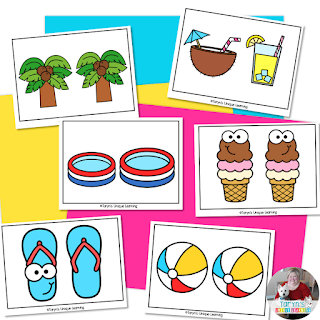
1. Summer Visual Discrimination Cards 

These visual discrimination cards have a fun summer theme and make great small group activities.
Visual discrimination is an important skill that helps our students train their eyes to see the subtle differences between letters. To help hone this skill in a fun way that feels more like a game than learning, give these Summer Visual Discrimination Cards a try in your room. In this resource, you get 84 different cards with two pictures on each one. There are pictures that are an exact match as well as ones with subtle differences in color, size, or orientation. Some differences are easier to spot than others. 

Before you begin, teach students two distinct hand movements to indicate if pictures are a match or not. (Think, a "thumbs up" or "thumbs down") You'll hold up one card at a time, and students will silently give their answers. This activity works well for small groups as well as an activity for your whole class. Either way, I know it will be a hit! 


2. Summer Syllable Count 

This summer syllable count is an exciting end of year center activity for primary learners.

Next up, a fun activity for learning to count syllables in words! This Summer Syllable Count includes 40
different numbered cards that feature different pictures. Students will choose a task card and write what number it is on their recording sheet. Next, they clap out the syllables and determine how many syllables it has. Then, they circle the number on their recording sheet. 

This is a wonderful activity for independent learning once students understand how to use it. You can set this up as a literacy station in your class and have students work through each of the cards. This resource also works well as a Scoot game, and I've even included heading cards if you prefer to have students sort cards by syllable. The variety allows you to use this resource in many different ways. 

3. Missing Letter Game

Using this summer literacy activity, students can practice letter order and recognition.
This Summer Missing Letter Game is a perfect addition to your literacy centers. Included there are 24 lowercase letter cards, 24 uppercase letter cards, as well as a recording sheet and an answer key. 

To play, students choose a card and study it to determine which letter is missing from the sequence. You can have students use magnet letters to fill in the missing letter on the card, or laminate the cards and have them use dry-erase markers to write it. The recording sheet is great if you want a way to keep students accountable for their work or prefer to play it as a Scoot game. 

4. Summer Letter Hole Punch 

This summer letter hole punch card allows students to practice first sound and letter recognition.
Looking for a way to practice letters while targeting hand-strength and fine motor skills? I know you'll love these Summer Letter Hole Punch Cards! There are 104 cards included in this download that print 4 to a page. The idea is that students identify the key picture in the center of their card  and the letter it starts with and then find that letter around the perimeter. They will hole punch each corresponding letter as they go around the card. 

These cards are in black and white, and since they print four to a page, you can easily cut them apart with a paper cutter. Just place the cards in a literacy center with reduced-effort hole punches and you've got a great hands-on learning activity to add to your lessons! 

5. Summer Letter and Sound Search

This image highlights a letter and sound search, which is the perfect summer literacy activity for primary learners.
Looking for a way to target letter recognition and sounds in your classroom this summer? This Summer Letter and Sound Search is one of my personal favorites to fill that need. It's super simple to prep and can be used over and over since there are a few different options. Included, you get:

  • 2 black and white worksheets with uppercase letters
  • 2 black and white worksheets with lowercase sounds
  • 4 black and white worksheets with beginning sound pictures 
  • 1 color deck of task cards - uppercase 
  • 1 color deck of task cards - lowercase 
  • 1 color deck of picture cards 
The idea is that students will receive a worksheet with the skill that you are trying to target, along with a stack of task cards to work with. They choose a card, find the match on their paper, and repeat. You can match lowercase to lowercase, uppercase to uppercase, cross-case match, or match pictures to beginning sounds. With so many options, I know you'll use this activity again and again in your classroom over the summer! 

6. Letter Fluency Spinner Game 

If you want to target letter naming fluency at the end of the year, then I know you are going to love this letter fluency summer literacy activity!

Letter name fluency and letter sound fluency are likely skills you're targeting in your literacy lessons. If so, I know you'll love this Summer Letter Fluency Spinner Game. This is a great activity to use as a small group warm-up, center station, or independent work activity. To play, students spin the spinner, identify the picture, and then find the match on their card. Then, they read across as fluently as possible with a focus on either letter names or sounds, depending on what you'd like to target. I always recommend that you laminate these cards as they're a great activity to use more than once in your classroom. 

7. Hidden Treasure Sight Word Game 

This summer literacy activity targets sight words and is sure to be a hit in your classroom.
Looking for a summer literacy activity to target sight words in your classroom? This Hidden Treasure Sight Word Game is sure to be a hit! Included, you get 100 different summer-themed sight word cards. I've used Fry's First 100 Word List for this resource. 

You will choose the number of cards you want to use at once and place them in a pocket chart. Then, hide the 5 included hidden treasure cards behind random words. Students will take turns pointing out a card and reading the word. If they read it correctly, they get to pull that card from the pocket chart and see if a hidden treasure is behind it! This is a great activity when engagement is low and you need something to snag attention and boost excitement! 

8. Summer CVC Spin a Word 

Students can spin and blend cvc words using this engaging summer literacy activity.
I was always looking for engaging ways to have my students work on blending CVC words. Instead of another boring worksheet, give this Summer CVC Spin a Word Activity a try! This resource includes work mats with spinner wheels. 

Students will lay a plastic spinner over the wheel and spin one by one. Each time they spin, they place a letter tile down for what they got. Once they have recorded all 3 letters, they read the word and then decide if it's real or not. There is also a recording sheet included if you'd like to have students also write the words they built and their choice on whether or not it's real. 

9. Summer Nonsense Word Sort 

This summer nonsense word sort is a great warm-up activity for small groups.

Next up, I've got another fun summer literacy activity that's super simple to prep and can be used in a variety of ways. This Summer Nonsense Word Sort is a great way to practice reading fluency and decoding. There are 60 different summer-themed word cards with a mix of both real and nonsense CVC words. I've also included headings for real and nonsense. Students will choose a card, read it, and decide which category it falls into. Then, it gets sorted into the correct group. 

This is a great warm-up activity for your small groups! Students can take turns choosing a card, reading the word, and sorting it into the correct category. Once they know how to play, it also makes a great partner activity to use in a pocket chart and work together. I've even included a recording sheet so that you can have your students write down their answers as they go. 

10. Nonsense Word Fluency 

This image showcases a fun nonsense word fluency center that is a great summer literacy activity for primary students.
Last on this round-up of summer literacy activities is a Nonsense Word Fluency Game that I know your kids will love! This activity works just like the letter fluency activity I mentioned above. Students will receive a card and a spinner wheel. They lay a plastic spinner on top of the wheel, spin, and identify which picture they landed on. Then, they find the same picture on their card and read the nonsense words in that section as fluently as possible. There are 5 different boards and 5 different spinners included, so you'll be able to assign this activity more than once to your students. 

The best part about this activity is that it's a fun way to practice blending CVC words. The nonsense words are sure to make your kids giggle and make working towards reading fluency an engaging activity that everyone will enjoy! 

Make Summer Literacy Fun! 

So, which of these summer literacy activities was your favorite?! I know it can be hard to choose, which I exactly why I used them all in my room. Using a variety of lessons, games, and center activities is the best way to ensure that your students stay engaged in learning. Don't forget, you can find all of these summer literacy activities, along with many more options, in my TPT Shop. Have fun planning!


Save This Post 

Make sure to pin this post on Pinterest so that you can come back to it when you're ready to plan summer literacy lessons for your classroom. 

Looking for some engaging summer literacy activities for primary learners? This post is full of 10 hands-on literacy activities that are perfect for centers and small groups at the end of the year.